 ROU
ROU
 SAV
SAV
 PES
PES
 PHA
PHA
 REN
REN
 NAB
NAB
 COM
COM
 COL
COL
Their Season is Over

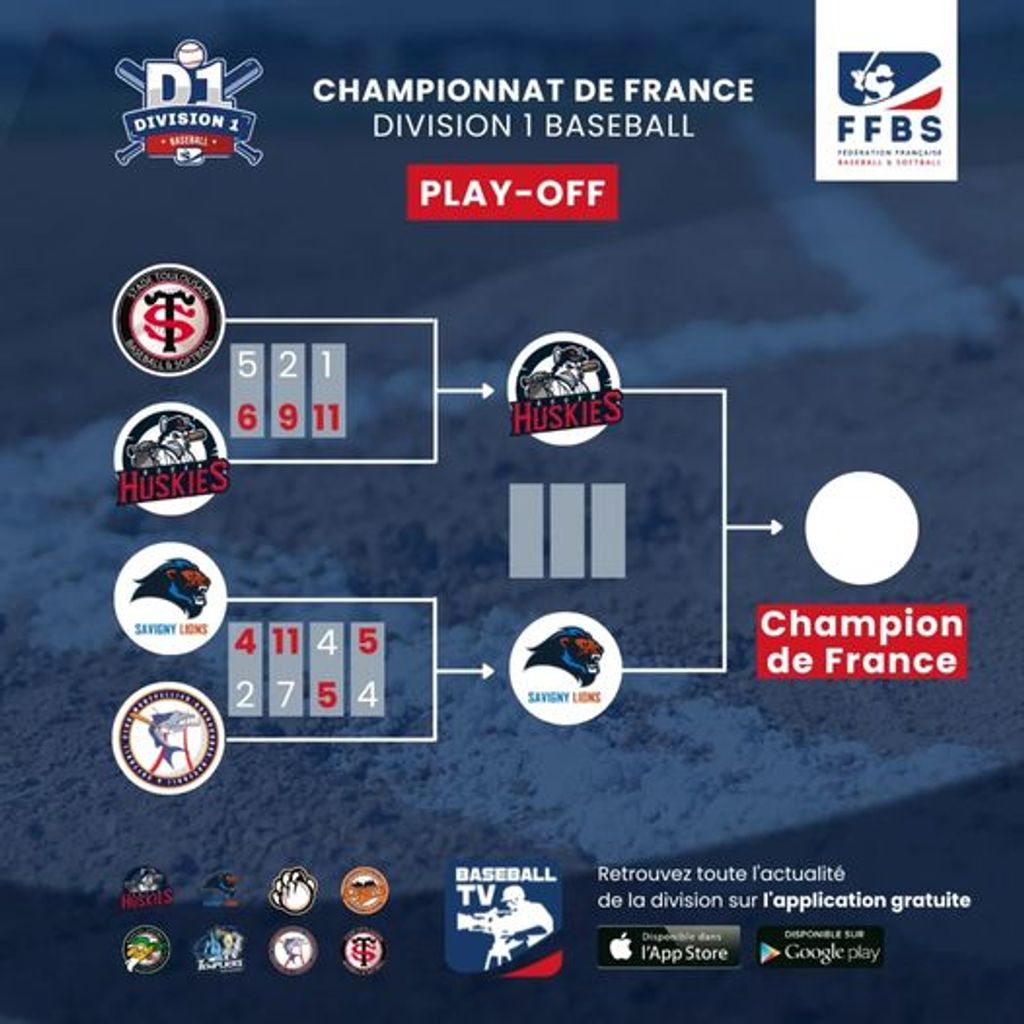
The top two teams advance to the final, while the 7th-place side survives at the expense of the 8th. The playoff/playdown results respected the hierarchy, though not without suspense. Baseball TV France takes a look at the performances of the four clubs after Metz and La Rochelle, who are now on vacation.
TOULOUSE TIGERS
For Toulouse, the semifinal mirrored their season: a strong first half, but a disastrous second half. In Game 1, the Toulouse side led 3-2 after 5 innings, in Game 2, it was still 0-0 after 4 innings, and they were ahead 1-0 in Game 3 after 4 innings. But then came the collapse, with relief pitching utterly incapable of holding the lead, much like Randy Perez (15.75 ERA) and Garcia-Delgado (13.50 ERA), who were far from the dominant closer of the season’s start.
The offense lacked depth. Across the three games, the bottom three batters in the lineup were silent, or nearly so: 1 hit in 28 at-bats. Coach Perez shuffled the lineup to spark something, but outside of Ariel Soriano, who recorded at least one hit in all three games (4 in 11), the rest were too inconsistent. After his 3-for-4 performance in Game 1, Mendoza went cold (0 in 7), Perdomo wasn’t convincing (3 in 9), and the young Toulouse outfielders showed their inexperience (3 in 20 for Saumande, Baisse-Depontieu, and Cegielski).
Of course, the Toulouse side can partly blame the lack of competition from Keivy Rojas, and his probable return of pain in his right arm, which forced him off the mound prematurely in Game 3. With just one earned run and 17 strikeouts in 10 innings, he shut down the Rouen offense. And if he had been at full strength, the outcome of the semifinal might not have changed, but it certainly wouldn’t have ended in three games. The absences of the Americans Esposito, Navarro, and Blancot also weighed heavily. Toulouse wasn’t at 100%, and that rarely forgives against the Huskies in the playoffs.
The absences can also be cited in defense of the Barracudas: Couvreur and Sigiura out, Monks, Zan, Antonac also on the other side of the Atlantic—that’s a lot of holes in the lineup. But Montpellier seemed tired, lacking energy, unable to turn the tide once Savigny took the lead. Leaving 27 runners on base in four games is a lot, proof that the big hits didn’t come at the right time. In the final three innings, where everything must be given to turn the game around, Montpellier batted just .200 as a team. More generally, the big hitters didn’t produce enough, like Douglas Rodriguez (2 in 15) or Bustamante (3 in 16), while the speedy Spring only stole one base. The pitching was also blunt. Canelon, who could only give three innings in a one-and-done game, was insufficient, even if coach Ozanich’s strategy paid off on this occasion.
MONTPELLIER BARRACUDAS
For a moment, it seemed Montpellier could turn the tables when the Barracudas scored four runs in the 2nd inning of Game 3. But Savigny likely remembered April 14th, when the Barracudas scored five times in the first inning, only for the Lions to immediately respond with five of their own. This time, they waited an inning to answer, but Montpellier will long regret the defensive error by pitcher Luc Polit, which opened the floodgates and allowed three unearned runs. The Barracudas tried something in the final inning with two runners on base, but a beautiful defensive play by left fielder Luc Viger ended the game. It didn’t take much—just a bit of energy, a bit of luck, a bit of everything—for the Montpellier side to fall short.
SENART TEMPLARS AND MONTIGNY COUGARS
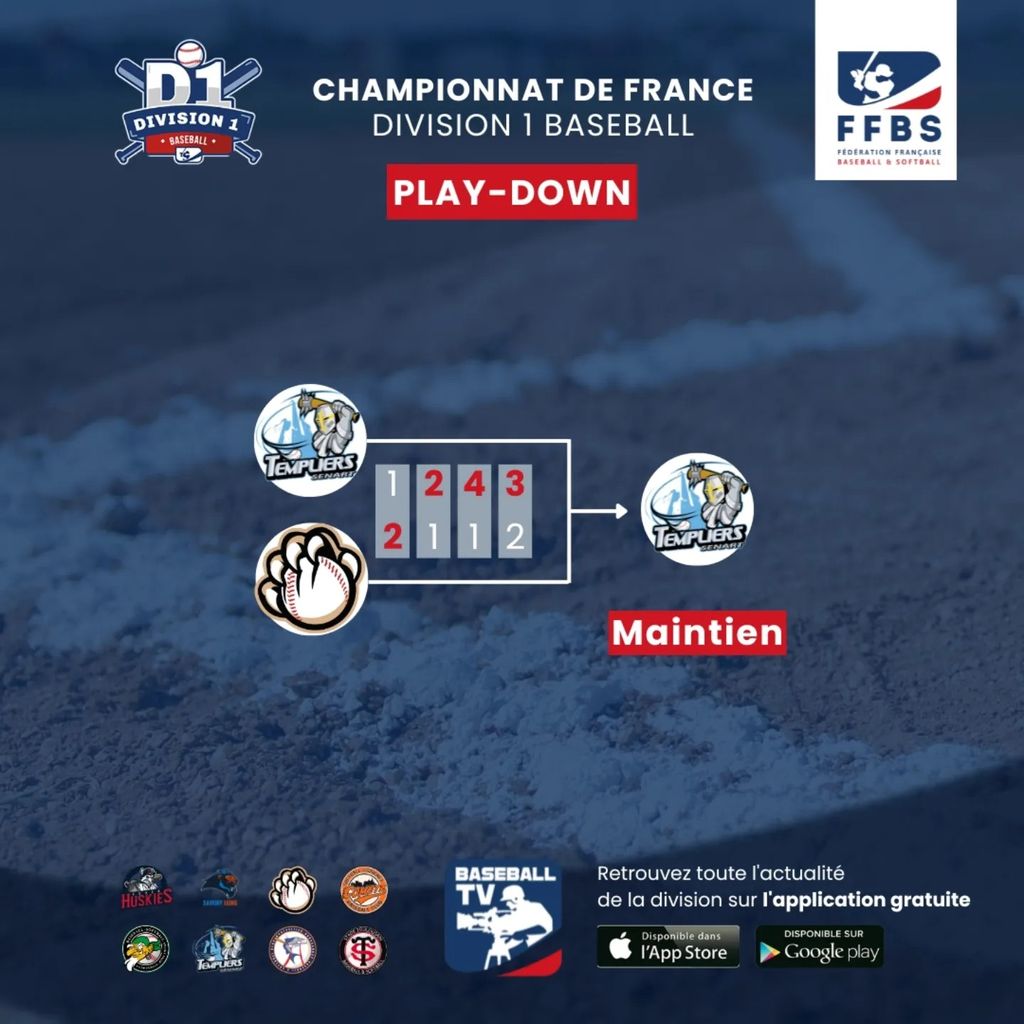
We continue talking about the absences, but this time in a winning team. Sénart, without Bouniol, Meurant, Nayral, escaped the Montigny trap. If we had to award an MVP for these two weekends, playoffs and playdowns combined, it would undoubtedly go to Émile Brelle: 17.1 innings, a 1.56 ERA, just 6 hits, 4 walks, and 18 strikeouts—a monumental performance. The trophy could easily be shared with his teammate Koshiro Kujima, who recorded two wins, gave up no earned runs in 19 innings, walked 3 and struck out 16. In short, the Templars’ pitching was monstrous, allowing the team to hold firm after the difficult 9th-inning defeat in the first game. While the experienced players were useful, like Ogawa (5 hits in the series), the young Templars played their part in these suspenseful games. Corenthin Flament scored the winning run in the 8th inning of Game 2 after a hit, on Brown’s triple (the veteran’s only hit, but a crucial one). And Tristan Laufenbuchler, who hadn’t hit an extra-base all season, smashed an important triple in the 7th inning of Game 3 to tie the game. It wasn’t perfect, sometimes laborious, sometimes excellent, much like their season, but the young Templars did what they needed to do.

It’s symbolic that Montigny’s season ended on an error in extra innings, an error by their ace Lopez, usually one of the best defensive pitchers. Symbolic of a season where nothing really worked. During these four playdown games, the Cougars managed just 18 hits and committed 7 errors, far too many. Dylan Mayeux was once again the team’s standard-bearer with 4 hits in 16 at-bats, but he didn’t get enough support. The pitching isn’t to blame, Monbeig was surprising, Mastre, after a dominant Game 1 (15 strikeouts), couldn’t contain the Templars’ offense in the 8th inning of Game 3, and Lopez, absent the first weekend, did his job (no earned runs in 9 innings despite 8 hits allowed), but he couldn’t do it all alone. The offensive depth and defensive composure weren’t there, and Montigny’s season ends on a sad, but logical, false note after a failed campaign.



React to this article
Community rules
Loading rules…