 MTP
MTP
 SAV
SAV
 LVS
LVS
 DUN
DUN
 ROU
ROU
 TOU
TOU
 LAR
LAR
 MET
MET
 MON
MON
 MUR
MUR
 HLG
HLG
D1F: A Season of Softball


The regular season has concluded, and now the curtain rises on the playoff stages.
Some teams have asserted their dominance with remarkable consistency, while others have had to adapt to the challenges of a young or rebuilding roster, but all have contributed to a season packed with intensity and emotion.
This 2026 edition has highlighted players capable of carrying their teams week after week, others who have stepped up over the course of the season, and emerging talents already signaling the future. Between standout individual performances, high-stakes matchups, and tactical battles, D1 women’s softball has confirmed its rising level and vitality.
Before turning to the semifinals and predictions, let’s review the season’s takeaways: team by team, we revisit the lessons of this season, the strengths, weaknesses, and dynamics that shaped the final standings.

Cavigal de Nice: A Tough Season, But Real Potential
Nice endured a difficult season, marked by pitching struggles, a shaky defense, and a cautious offense. The record speaks for itself: three wins, seventeen losses, and twelve mercy rule games. Yet, the team showed it could shift gears quickly.
The month of June was a revelation. The arrival of Emma Flayol transformed the Cavigal, bringing immediate stability to the pitching staff, decisive offensive contributions, and renewed energy. With her, Nice reached the semifinals of the Challenge and posted a 3-1 record in the league. Her statistics tell the story: a .533 batting average, a 1.534 OPS, a solid defense, and pitching that finally allowed the team to breathe.
Nice also showed flashes of brilliance throughout the season. The walk rate was the highest in D1, young players posted a combined OPS of .798, and the pitching staff generated more strikeouts than some better-ranked teams. The defense led the league in double plays, proving the potential is real. The young players (born after 2004) performed well at the plate, producing an OPS of 0.798, signaling a promising future for the Cavigal.
But the challenges were too great to expect a better finish. The bullpen allowed a .384 batting average against, the team’s ERA was the highest in D1, and the defense committed 4.40 errors per game, generating over five unearned runs per match. The offense lacked consistency, with a .210 batting average and a .054 ISO, the lowest in the league. Base-running aggression was also lacking, with just 1.15 stolen base attempts per game. Nice is a young, courageous team capable of strong stretches, but it must stabilize its structure to take the next step.

Grizzlys de Grenoble: A Season of Transition, Full of Youth and Challenges
Grenoble had a difficult, even underwhelming season, finishing fifth with a young roster, an unstable battery, and pitching struggles. The bet on youth brought surprises but also instability. The 5-15 record reflects a team still building itself, and the Grizzlys will have to fight to stay in the division.
The offense was one bright spot. Diane Simon was the standout, with a .473 batting average and a 1.133 OPS, placing her in the top 10 of D1—she’s the rookie of the year! Korousova, Boudousq, and Patin added power, while several players showed great base-running aggression. Grenoble was the most audacious team in the league, with 26.4% stolen base attempts and an 88.1% success rate.
But pitching was the main hurdle. The pitchers walked too many batters, threw too many wild pitches, and allowed too many hits by pitch, while failing to generate enough strikeouts. The defense, overwhelmed by 453 balls in play, couldn’t compensate, with a .867 fielding percentage and over five unearned runs per game. Still, Grenoble relied on three main pitchers (Victoria Biteur, Manureva Salze, and Ellie Bouis), and Victoria Biteur stood out with strong control (3.35 BB/7, 3 wild pitches in 38 innings).
The offense, despite standout performances from players like Diane Simon, Kristyna Korousova, and Hermine Boudousq, was too impatient. The walk-to-strikeout ratio was the lowest in the league, reflecting a fiery approach that still lacks discipline. The Grizzlys were aggressive on the bases and capable of explosive offensive bursts, but overall inconsistency kept them from competing over the long term. A season of transition, full of promise but also lessons.

Wildcats de Colombes: Courageous, Talented, But Limited
Colombes had a mixed season—strong against lower-tier teams but unable to compete with the best. The 5-3 record against Grenoble and Nice contrasts sharply with the 0-12 mark against the top three. The Wildcats showed heart, talent, and a real ability to create offense, but structural weaknesses held them back.
The pitching, split between Laurie Saurat (3.73 BB/7, 6 wild pitches in 50 innings) and Estelle Meyer (1.039 OPS), was steady but rarely dominant. Saurat showed excellent control, Meyer limited hits, and this stability allowed the catchers to allow only eight passed balls, the second-best total in D1. The top of the lineup was highly effective, led by Meyer, Viguier, Poley, and Alvarado Torres, who could hit for power, advance on base, and keep the pressure on. Micha Labatut was a nightmare for opposing pitchers (10 walks taken).
Colombes was also aggressive on the bases, capitalizing on every opportunity to advance. Several players showed remarkable discipline, including Garance Viguier (2 strikeouts in 55 plate appearances), Marie Ten Eyck (1 strikeout in 31), and Shahineze Souici (1 strikeout in 45), nearly eliminating strikeouts from their game.
But the limitations became clear when facing higher-level competition. The pitching lacked power, with just 3.01 strikeouts per seven innings, the worst in D1. The defense struggled, especially at catcher, allowing 61 stolen bases while recording only two outs. Errors cost them dearly, with 3.20 per game and 39% of runs allowed being unearned. The bottom of the lineup underperformed, giving opponents easier innings. Colombes is a courageous team capable of strong stretches, but it must strengthen its pitching and stabilize its defense to move forward.

Panthères de Pessac: A Strong Team, But Not Yet at the Top
A clear dominance over Grenoble, Colombes, and Nice (11 wins, 1 loss). Against Évry, the Panthères lost the home-field advantage in the semifinals but also secured two crucial victories, proving they can compete with an elite team when their collective timing is right. Against Saint-Raphaël, the climb remained steep, but Pessac was never overpowered—they forced the best to play their best.
Pessac relies on remarkable zone mastery, both on the mound and at the plate. Louise Le Chenadec embodied this discipline with an outstanding season: 80 innings pitched, 9 complete games, a 2.80 ERA, and the league’s best strikeout rate. Her presence allowed the bullpen to post the best ratios in D1, but it also revealed a heavy reliance on her—68% of the team’s innings came from her. Behind her, the other pitchers were courageous but less dominant, which hurt them in matchups against the top offenses.
At the plate, Pessac excels in game reading. The walk rate is among the highest in D1, the strikeout rate the lowest, and the Riera–Graves–Gourgue trio carried the offense with rare tactical intelligence. Camille Riera and Mylène Graves combined contact with extra-base hits, while Isaure Gourgue was the league’s most astute player, turning every duel into a strategic advantage. This finesse allowed the Panthères to build long innings and wear down opposing pitchers.
But this mastery comes with a lack of power. No home runs, an ISO of 0.067, and just 16.8% extra-base hits: Pessac advances on base often but converts less effectively than its direct rivals. The defense, solid overall, didn’t generate enough quick plays to shorten innings, with only two double plays and no runners caught stealing. The team is brilliant in game reading but must add power and depth to compete with the best.

Pharaonnes d’Évry-Courcouronnes: Power, Discipline, and Elite Defense
Évry delivered a remarkable season, driven by an exceptional defense, a powerful offense, and solid pitching despite the absence of their ace (Eidy Carolina Tortolero, due to a happy event). The youngest team in D1 showed rare maturity, building an identity around power, speed, and precision.
After spending years in the outfield, Rosalie Coste stepped into the starting pitcher role with flair, limiting hits and mastering her zone (WHIP of 1.52). The defense was the best in the league, with 25 double plays, a .939 fielding percentage, and the ability to contain stolen bases. Évry allowed only 1.51 unearned runs per game, a league record.
The offense is one of the most feared in D1. Ambre Brouard, Lila D’Hauteville, Rosalie Coste, Emma Liminier, Jade Aubard-Cojan, and Océane Lecourt Millet all posted OPS above 1.100. The ISO of .169 is the highest in the league, a sign of their ability to hit for power and often. The Pharaonnes are also the most effective base stealers, with a 90.8% success rate.
The defense is equally strong, combining efficiency and flair, as evidenced by the 25 double plays and a .939 fielding percentage, the best in the league. Behind the plate, the catchers imposed a strong deterrent on base-running, with Elsa Lepinay intercepting nearly a third of opposing attempts. This collective strength allowed the Pharaonnes to minimize damage, finishing the season with the lowest volume of unearned runs in D1—just 1.51 per game.
But Évry was completely stifled by Saint-Raphaël. Against the Comanches, the offense was reduced to two runs per game, the OPS dropped to .515, and strikeouts surged (24.8%). The power hitters struggled to make contact when facing elite pitching. Évry is an elite team, but Saint-Raphaël remains their glass ceiling.

Comanches de Saint-Raphaël: A Perfect Season, Total Dominance
Saint-Raphaël had a perfect season, undefeated, with thirteen mercy rule games out of twenty and total dominance across all aspects of the game. The Comanches were superior to their opponents in power, precision, depth, and control.
Prapeng De Ridder had a historic season, allowing just one earned run in nearly forty innings, with 8.82 strikeouts per seven innings and 1.94 walks per seven. Enora Simon added ten perfect innings. Behind them, four pitchers (Marjorie Brunel, Élise Buvat, Alice Chanal, and Farah Saïdi) posted a combined ERA of 3.13—something any other team would envy.
The defense is the best in D1, with 73.9% outs on balls in play and 36.8% of stolen bases caught. The offense is led by Pauline Prade, the league’s top hitter and best base stealer, but she’s well-supported by Vieira, Haudiquer, Brunel, and Péan, all with OPS above 1.100. Melissa Mayeux added explosive power in the summer.
The only downside is lineup consistency. The veterans posted a combined OPS of 1.497, while the young players maxed out at 0.727. The rookies faced 42% of the plate appearances but had a high strikeout rate. Saint-Raphaël is developing its youth, but success still depends on its veterans.
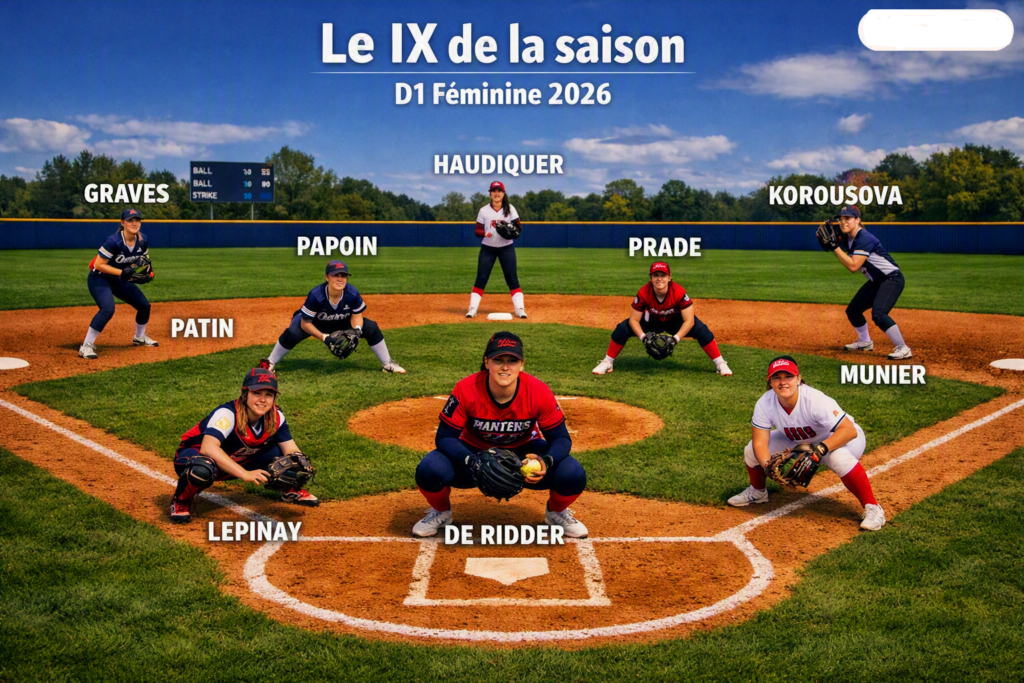
The Season’s Best XI (Editor’s Pick)
Pitcher: Prapeng De Ridder, Saint-Raphaël
A perfect season. Just one earned run in nearly forty innings, a 0.18 ERA, total dominance over opposing lineups, and the ability to set the tone from the first pitch. De Ridder is the pitcher who changes the fate of a team. She is the cornerstone of this lineup.
Catcher: Elsa Lepinay, Évry
The best defensive catcher, with surgical precision, just one passed ball in twelve games, and a 31% interception rate. Lepinay is the catcher who elevates a pitching staff, who reassures, who locks down the defense. She is the backbone of the defense.
First Base: Elsa Munier, Saint-Raphaël
A brilliant offensive season, an OPS near 1.000, and flawless defensive play. Munier was the most complete first baseman in the league, solid on quick plays, reliable on tough balls, and dangerous at the plate.
Second Base: Lisa Papoin, Évry
A reliable player, rare game intelligence, a .443 OBP, and a defense that exudes mastery. Papoin is the second baseman who stabilizes the infield, makes the right decisions, and turns average balls into sure outs.
Shortstop: Pauline Prade, Saint-Raphaël
The best player in the league. A historic offensive season, an OPS of 1.806, devastating speed, and immense range. Prade is the heart of the infield, the player who changes everything, who can turn a match with a hit, a steal, or an impossible defensive play.
Third Base: Shirley Patin, Grenoble
The most reliable third baseman in D1. Just one error all season, above-average range, and a .500 OBP. Patin is the player who secures the hot corner, absorbs pressure, and turns tough plays into routine.
Left Field: Mylène Graves, Pessac
An exceptional offensive season, perfect defense, no errors, and the ability to read trajectories with rare precision. Graves is the outfielder who combines power, speed, and reliability.
Center Field: Inès Haudiquer, Saint-Raphaël
One of France’s best players. An OPS of 1.406, immense range, and zero errors in center field. Haudiquer is the queen of the outfield, the player who erases others’ mistakes and turns tough balls into natural outs.
Right Field: Kristyna Korousova, Grenoble
A specialist at the position, with confirmed power, a home run, a triple, a .976 OPS, and above-average range. Korousova is the player who brings power to the right corner while securing long trajectories.
Sébastien Dondé + correspondant local
Design clubs: Lucas Arrighi.



React to this article
Community rules
Loading rules…