 ROU
ROU
 SAV
SAV
 PES
PES
 PHA
PHA
 REN
REN
 NAB
NAB
 COM
COM
 COL
COL
Season Review


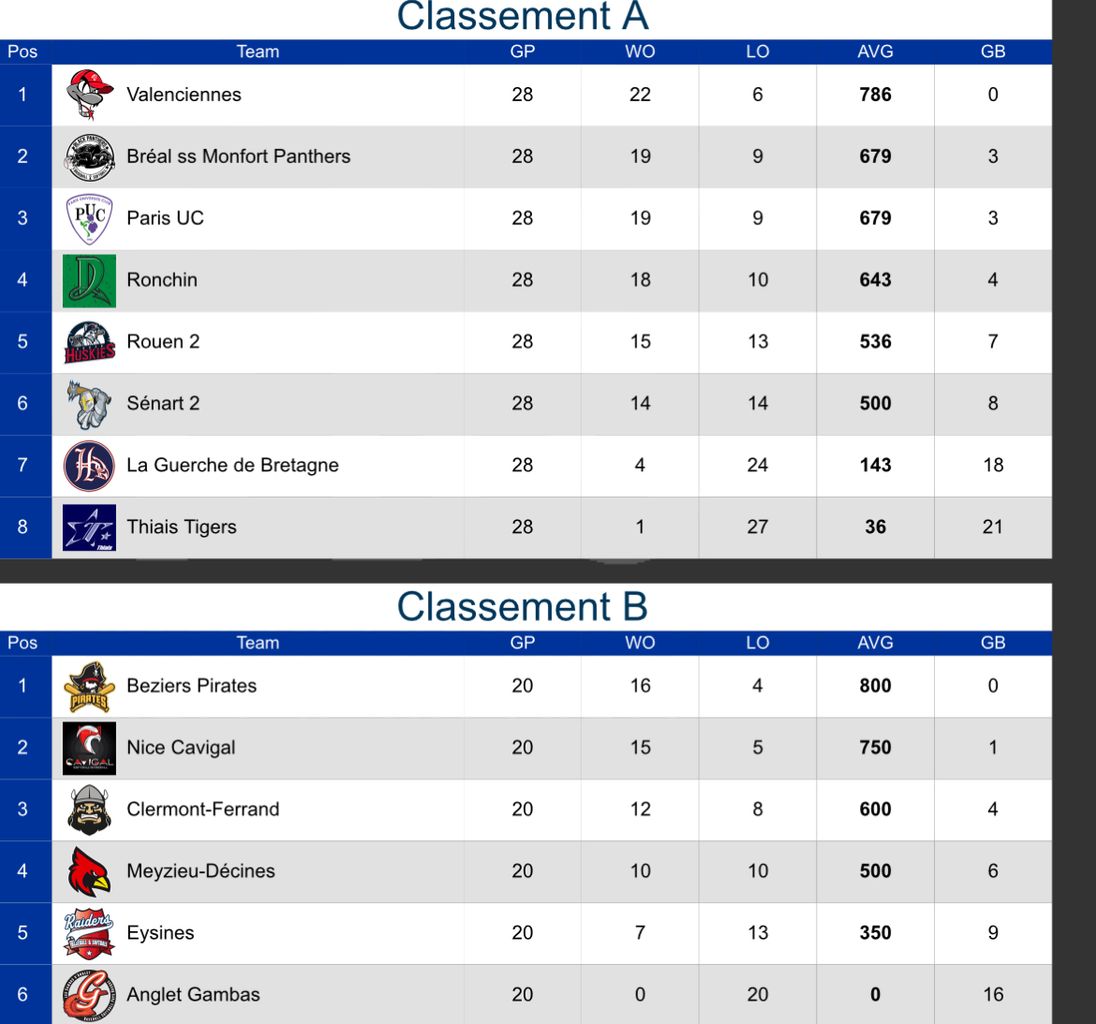
14 matchdays, two pools, one with 8 teams and one with 6, 28 games played by Pool A teams and 20 by Pool B teams. Valenciennes topped their pool with 22 wins, and Béziers finished first in Pool B with 16 wins.
The playoffs and playdowns will begin at the end of September. Three teams from each pool finishing in the top three will compete in the playoffs. The second and third-placed teams from each pool will face off, mixing the pools, with Bréal against Clermont and Nice against the PUC. The winners will then face the top teams, Valenciennes and Béziers.
The champion of these playoffs will have the chance to move up to Division 1 without going through the playoffs. They will automatically replace the team that loses in Division 1, with the relegation battle between Sénart and Montigny being a best-of-five series.
Before looking at what the line-ups for the Division 1, 2, and 3 teams might be next year, let’s review this year in Division 2.
Out of the 14 teams competing.
Those for whom the level was too high
Two teams fell short this season (Anglet with no wins and Thiais with just one), facing well-established teams bolstered by foreign reinforcements, the battle was not fair. Eysines (seven wins) and La Guerche (four wins) are in a better position and can hope to stay in Division 2 to progress steadily. Generally, these struggles stem mainly from weak and inconsistent pitching. These four teams have an ERA above 7 for Eysines and even 11 for the other three.
Those aiming for survival
Nice and the PUC, forcibly relegated last year when Division 1 expanded from 8 to 10 teams, have focused more on consolidating their position, and the JFL rules suit them well given their strong ability to develop young talent. They are in a position to win the playoffs but haven’t shown the ambition this year to return to Division 1 immediately, so survival would suit them just fine.

Those looking to avoid relegation to D3
The second teams of Sénart and Rouen are in the same boat, with no intention of challenging for promotion. These are reserve teams for Division 1. However, if Sénart 1 loses their relegation battle against Montigny in D1, it would automatically mean the second team would drop to the new D3, which is being set up for 2025. The playdowns are a reality for these two teams, and they will have to fight against Eysines, La Guerche, Anglet, and Thiais to keep their place in Division 2.
Those already on vacation
Ronchin and Meyzieu, finishing mid-table, do not qualify for the playoffs and have no playdowns to play. Their respective batting averages (.258 and .212) and pitching ERAs (4.62 and 6.93) are, however, fragile for both teams. Next year, it might be more complicated in a D2 still split into two pools but with only 12 teams.

Those aiming for promotion
Only one team has openly expressed their desire to move up if they become champions: Béziers. As for Valenciennes, this promotion is seen as premature. Clermont-Ferrand briefly wanted this promotion, but everyone knows that financially and administratively, access to Division 1 is a completely different economic model.
Sportingly, these three teams offer very interesting averages that would allow them to compete honorably if Division 1 were within reach. What needs to be remembered is that this decision to move up will be a heavy one for the winner, taken late in the off-season. The relegated team from Division 1 will be suspended pending this decision by the Division 2 champion, and this could be mentally challenging.

The standout players
On the pitching side, Nicholas Dazell of Béziers delivered an even stronger performance than in 2023. An ERA of 0.47 that commands respect (1.63 in 2023). Cyril Beaurepaire, a French pitcher from Ronchin, also shone with his talent this season; he finished with 12 wins and a very impressive ERA of 0.83.
On the batting side, Jonathan Montas of Nice, who often sparkled as one of the top batters when Nice was in Division 1, boasts a .500 average over 20 games played. The top French player is Sébastien Duchaussoy (Rouen 2), who also has Division 1 experience with a .425 average over 22 games played.
In conclusion
Two or three of the current 14 teams will not continue their Division 2 journey in 2025. Each year, the level of D2 rises, offering matches often as interesting as those in Division 1. The JFL rules have also contributed to their success by giving much more playing time to French players, regardless of their position, especially pitchers.
A 12-team division next year is still being considered in two pools, as clubs are not ready to assume national travel costs during the regular season. This is becoming increasingly difficult to organize, as northern France, particularly around Paris, has many more clubs than the south.


1 comment
-

SCH35
See the 1 commentAvec une bizarrerie dans la formule des Playdonw. Anglet (dernier poule D2B) va affronter à Rouen, Thiais (Dernier poule D2A) et Rouen (5e D2A).
Les derniers s’affrontent donc au 1er tour des Playdonw.
Une bizarrerie car le calendrier envoyé aux équipes en début de saison ne donnait pas cette formule.
Community rules
Loading rules…