 PHA
 COM
 ROU
 SAV
 PES
 REN
 NAB
Regular Season Review D1


We’re here: the regular season has delivered its verdict and the Playoffs are now on the horizon. Eight teams fought throughout the season to secure the top four spots, but also to avoid the bottom position, as the stakes were high at both ends of the standings. A season of performances, consistency, standout moments, but also of more challenging periods. Some players were present throughout the season and carried their team week after week; others, more constrained by availability, had a more irregular season.
Yesterday we also launched a big poll to elect the regular season MVP. The editorial team narrowed it down to four candidates, looking to go beyond a simple reading of the stats. While individual performance is obviously a key criterion, we also wanted a balanced selection between pitchers and position players, between JFL and foreign players, and between those with significant playing time and those with more sporadic roles. Experience was another factor. This selection pits seasoned D1 veterans against younger, even rookie, profiles who proved themselves this year. Now it’s up to you! Vote for your MVP on the app and on the site.
But before we project ourselves to the semi‑finals and deliver our predictions, let’s review. Team by team, we’ll look back at this regular season to analyze what worked, what didn’t, and the lessons to take before the Playoffs.

Béziers
What worked.
Despite many offseason departures, the Pirates managed to renew their roster. Limouzin was one of the season’s revelations (.261, 16 RBI, 17 BB), Montagne, used at several positions, was solid, Tanigawa established himself in center field (0 errors) and finished the year as a cannonball (9 in 17 in his last 4 games). Meza confirmed his very high level, improving on last season’s stats, proving he is not only the best shortstop in D1 but one of the top 5 players, maybe even the top 3. More broadly, the Béziers offense, with 15 games of 10 hits or more (as many as the Barracudas), was very strong. Béziers can also celebrate being the only team to beat Rouen 3 times out of 4. That’s no small feat!
What didn’t work
Pitching overall, and even Gonzalez, was less dominant than last season, with fewer innings and strike‑outs. What cost the Pirates dearly was a bullpen that couldn’t do the job and ruined many game endings. Offensively, we saw a sad trend of hitting into double plays, as evidenced by Pilar’s 11.
La Rochelle
What worked
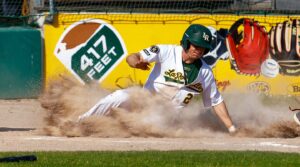
A lot of consistency, solid home play (10-4) and especially on the road, which wasn’t the case before (7-7). The ability to react at the end of the schedule. High‑caliber individual performances, including Pena’s 29 RBI, Rosell’s great season, and Briones’ confirmation of all his talent, one of France’s best hitters. De La Rosa’s end‑of‑season after early struggles (2.02 ERA over his last 8 starts, 45 K in 49 IP). The revelation of Krzykawiak, who, aside from 3 or 4 poor outings (understandable given his experience), helped the Boucaniers excel in JFL games. The efficiency of the Paredes‑Nieves duo at the end of games.
What didn’t work
The first inning! La Rochelle scored only 9 runs in that opening, the lowest total in D1. The Boucaniers were fragile against the other three playoff qualifiers (4-8). A defense that committed errors in only three games, the lowest total in D1. A lack of production in the lower part of the lineup (only .181 at the 9th spot). Difficulty finding stability in the lineup, with many position changes in the batting order.

Montpellier
What worked
An unstoppable offense, with no fewer than 7 hitters with over 10 RBI and 6 above .340. Nice performances like the 23 RBI of young Nayral, Mendez’s .383 or Doat’s .373, Farina’s .414 with runners in scoring position, but above all Brossier’s near‑perfect season, finishing at .459 and 1.157 OPS, hitting in 24 of 26 games, including 16 multi‑hit games (only Meza matched that). He’s also the best two‑pitch hitter at .351, hitting .640 on the first pitch or .571 with runners in scoring position. In short, an MVP season. Also note the brief but stunning stint of Ben Couvreur on the mound (33 K in 16.1 IP, only one earned run).
What didn’t work
The bullpen had the second‑worst ERA in D1 (7.84 vs. 8.08 at PUC), and that’s the big problem for the Barracudas, whose pitching didn’t live up to expectations. Notably, 17.2% walk‑rate, the highest in D1, or the low 56.4% left‑on‑base, the second lowest. This led to some heavy defeats and 5 mercy‑rules. The defense had some empty‑handed moments, but it improved at the end of the season (3 errors in the last 6 games). Finally, should we worry about the 4 losses to finish the season against direct rivals (Rouen and Savigny), conceding 48 points?

PUC
What worked
Not much, but the Parisians can be proud of having the best individual performance of the season, with Bowers’ 3 HR and 7 RBI against La Rochelle (he also had 12 of his 22 RBI against the Boucaniers) and the best comeback with a 9‑run inning against Béziers, tying 9-9, but ultimately losing the game. Gonzalez, when he was present, was one of the great players in the league, and Reyes perfectly replaced him. We also appreciated Julian Dussart’s promise, both as catcher and shortstop, finishing with a WPA of 0.6, the second in his team (Bowers 0.9).
What didn’t work
The inability to hold a result, and several wins that were abandoned. Two numbers explain it: shutout innings, i.e., the ability to not give the opponent points right after scoring. PUC is only 43% successful, the only team below 50%. And also base‑discipline issues, with too many base‑retreats (stretching a pick‑off, being caught by a line‑drive), 17, the highest total in D1. The learning curve was tough for the two young pitchers Le Guillou and Rolland‑Diamond, whom we hope to see in better conditions. German never really was the expected leader on the mound, while Bowers gradually faded at the end of the season.
Rouen
What worked
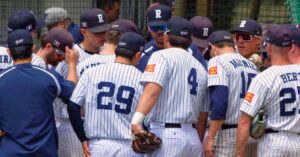
The end of the season… The Huskies, after a painful walk‑off loss in Toulouse, could start to worry about their playoff spot. They responded like champions and won the next 7 games, finishing just behind Savigny. The Huskies reminded everyone, if needed, that they are never better than when they really need to win. As usual, the Huskies displayed very solid defensive qualities and pitching well above average. Rouen was also the only team with a positive record on the road (8-6) and undefeated when they scored the first run of a game (17-0).
What didn’t work
It’s hard to blame their performance on two players who combine 9 HR and 44 RBI, but Megumi and Nishikawa didn’t quite meet expectations, with 66 strike‑outs between them and .268 with runners in scoring position. The Huskies lacked productivity throughout the season, for example leaving bases loaded 25 times. Problems at the top of the lineup (.175 team average) or starting innings, with 31.5% leadoff on base, the lowest total in D1.
Savigny
What worked
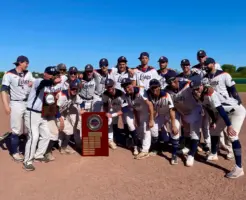
As usual, the offense ran full throttle, with an Acuna who never stops impressing, signing a season above .400. A. Amoros was a point‑producing machine (28) and his brother Lilian stood out with 4 home runs. After a less productive first half (.294), Nunez broke through in the second half (.364). And the young Grosjean‑Gardaix, Bernardi‑Chiba and Martinez‑Bouvier took their share, as Chevet on pitching, author of some beautiful outings, while Pena dominated all season and Orozco remains an indispensable finisher, with a remarkable propensity to throw strikes (76%). Finally, Savigny was a near‑perfect force, almost untouchable (12-2) at their “home” in Chartrain.
What didn’t work
Defense, starting with shortstop, with 17 errors committed, the highest total in D1. Acuna took responsibility for the position, but it’s not his natural spot. With 64 errors, Savigny has only one less than PUC, and turned the fewest double plays (0.58 / 9 innings). The foreign recruit Martin showed little, and Keurinck took a hard hit in his second year.
Sénart
What worked
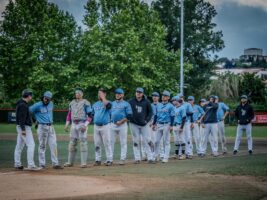
Some solid individual performances, including Do Carmo, who finished as the season’s best base‑stealer, in addition to batting .372. Yorfrank Lopez was also an important offensive engine with his 21 RBI and Dylan Mayeux had one of his good seasons (.281, 15 RBI). Brown’s return was a great boon, the veteran delivered three doubles and three triples with reduced playing time. Encouraging was the play of Landry and Picard, who are becoming a shortstop. Finally Dougals Rodriguez did Douglas Rodriguez (.418, 1 HR, 9 RBI). On pitching, Vera was remarkable, except against Rouen and E. Brelle had some great outings.
What didn’t work
The Knights hit their glass ceiling against the top‑4 (4-12), and especially against the Huskies (0-4, 49 points conceded, 6 scored). The 6‑game losing streak in the middle of summer (including 2 forfeit) cut the momentum of a 6‑game winning streak that had propelled the Knights to first place and may indicate some mental fragility. A lack of depth in pitching made it sometimes difficult to find solutions behind Brelle and Vera. A lower part of the lineup sometimes too fragile.
Toulouse
What worked
Game endings, with 4 walk‑off wins (and a 4-0 record in extra innings), Toulouse is also the team that scored the most points in the 9th inning. The always reassuring presence of veterans like A. Soriano, who remains a formidable hitter, and Velazco. The chance given to young players, well seized by I. Bamberger. L. Perez has increased in power year after year (22 hits vs. 6 last year) a Chaligné, still a bit off‑swing but who showed good qualities behind the plate. Good performances from Laot, who clearly passed a milestone, while he was used in relief or as a starter, without a fixed position, which is never simple. He finished the season with the most strike‑outs in a game, 14 against PUC. The effectiveness of Rojas in short relief.
What didn’t work
Starting pitchers never – or almost never – allowed Toulouse to fight on equal footing, finishing with a 3-14 record and a 7.74 ERA. The offense wasn’t productive enough (.225 team average, 127 points scored, 5 fewer than PUC), with some serious dips like Cegielski’s .328 in 2025, .181 in 2026 or the smaller Baisse‑Depontieu’s .300 and .245. Difficulty dominating at home, only 8-6, when it was a force in the past.

React to this article
Community rules
Loading rules…